On October 8, 2026, Franziska Zirker (Weizenbaum Institute) hosted the workshop “Visualizing Situatedness – Situational Analysis through Maps and Collages” at the Weizenbaum Institute. This creative, hands-on session introduced participants to situational analysis as a qualitative research approach and explored how visual mapping and collage-making can help researchers reflect on the complexity of the situations they study.
In the first part, participants received a theoretical introduction to situational analysis, tracing its development from grounded theory through the interpretive turn to postmodernism. Situational analysis recognizes that researchers actively participate in the production of knowledge which is always partial. Rather than striving for formal truth, it focuses on differences and contradictions, centering on the relational ecology of a situation. Its aim is to produce sensitizing concepts that shape how we can think about a phenomenon while remaining open to revision. Whereas grounded theory relies mainly on coding and constructing categories, situational analysis places mapping at its core.
The approach offers three analytical strategies:
1) Situational maps lay out the relevant elements of a situation and the relationships between them.
2) Social worlds/arenas maps lay out collective actors and the issues that bring them into conflict or negotiation.
3) Positional maps lay out controversies and examine the positions taken and not taken.
Guided by the question about what is present in a situation and how these elements transform it, mapping serves two purposes: early on, it helps make prior knowledge and assumptions explicit and guide theoretical sampling; later, it opens up the analysis and avoids premature closure.
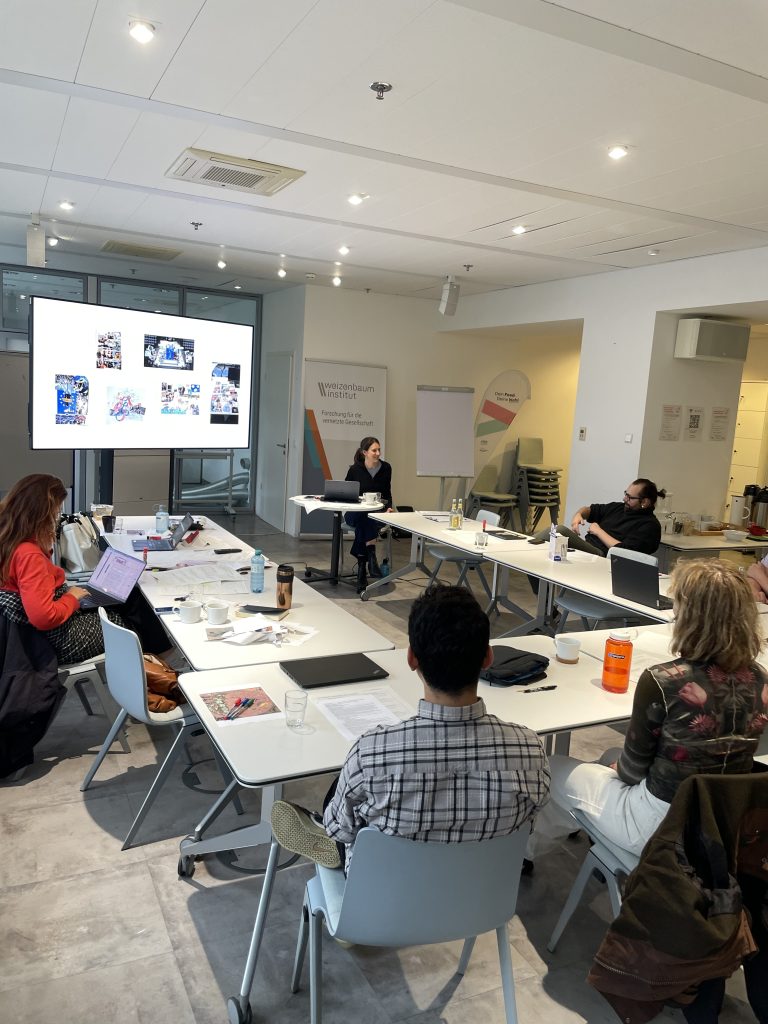
The core of the workshop was hands-on work with participants’ own research projects. Participants first created a messy map of their research situation and then transferred it into an ordered situational map template (Clarke, Situational Analysis, 2nd ed., 2018, adapted by Franziska Zirker), followed by a short written reflection.
In the next step, participants turned their maps into visual collages. By cutting out and arranging images, they experimented with how relationships between elements can be represented through spatial composition. The process was deliberately iterative, as participants continually added to and revised their collages by searching for and printing new images whenever they felt something was missing.
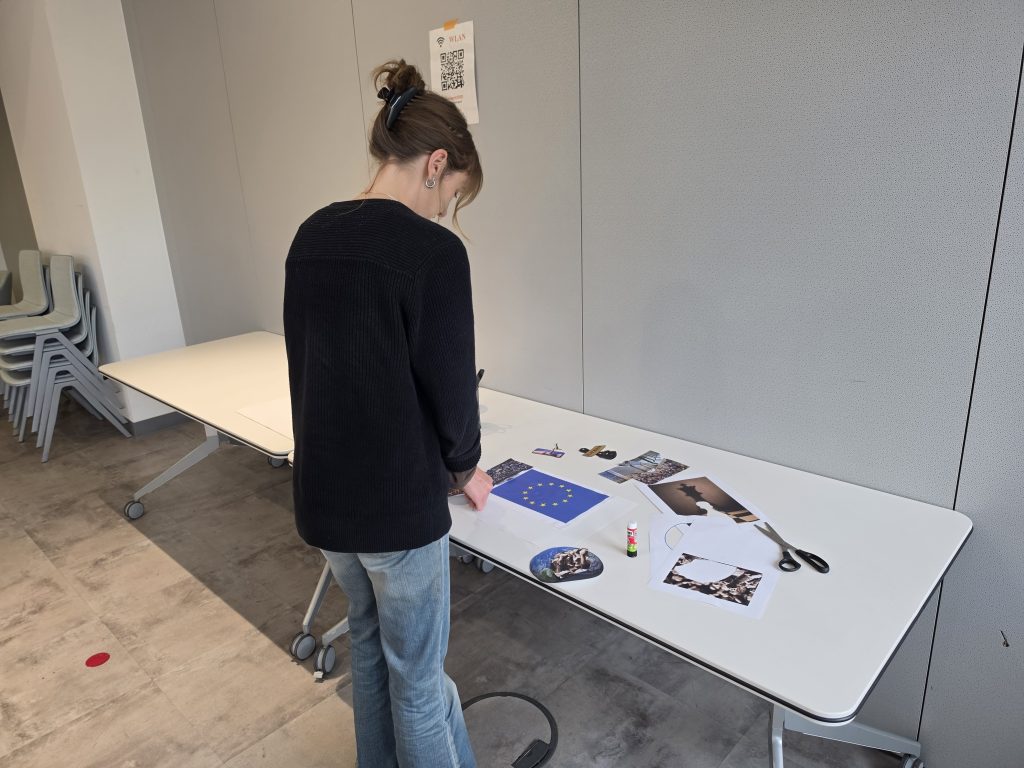
In the final segment, each participant presented their collage in a short lightning talk, followed by a collective reflection on the collage-making process. A key insight was how the visual work brought overlooked elements to the surface.
In one project on biometrics, for example, children had previously been represented only in relation to the collection of their biometric data, emphasizing the process rather than the children themselves. The collage instead positioned them as actors in their own right.
Participants left with a practical understanding of situational analysis and fresh, creative ways to reflect on their research and uncover relations that otherwise might remain hidden.