The fourth edition of our Introduction to Programming and Data Analysis with R workshop took place on March 25 and 26, 2026 continuing the tradition of hands-on, beginner-friendly training in R—a powerful tool for data science and statistical analysis. For those who attended previous editions, the structure and content remained familiar and effective: a two-day immersive experience covering the fundamentals of R syntax, Markdown/Quarto, data wrangling, analysis, visualization, and reproducible research practices. If you are new to R, or looking to refresh your skills, this workshop remains a great starting point.
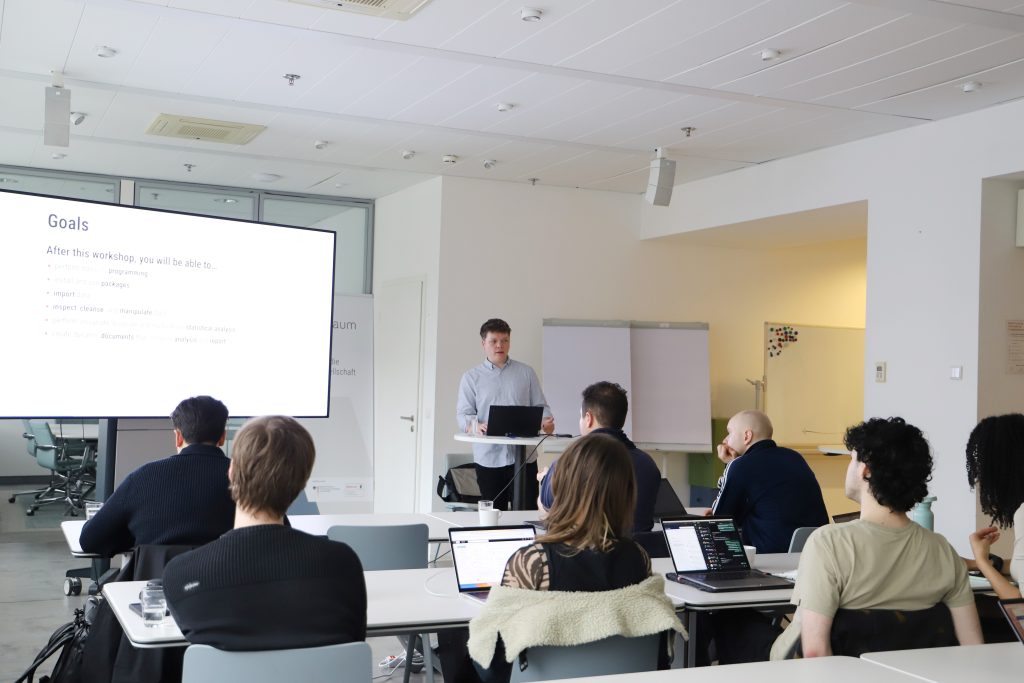
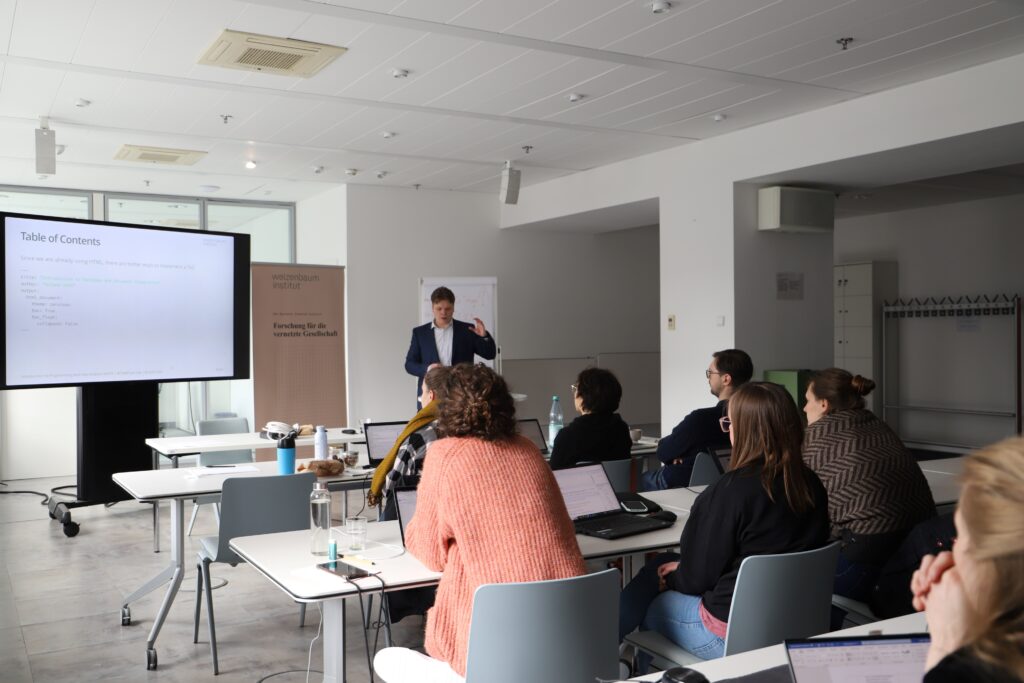
Roland Toth provides an overview of the workshop goals
We’re proud to see a consistent number of participants attending each year. The workshop’s format has been shaped by feedback from past attendees, and we have kept the core curriculum intact to ensure a smooth learning curve. If you missed this year’s session, you can still explore the material through our previous recaps:
These posts offer summaries and key takeaways—perfect for catching up or preparing for the next edition. Stay tuned for updates on the 2027 workshop, and keep coding with R! 📊💻
The Methods Lab is happy to welcome back the fourth annual Programming and Data Analysis with R workshop, led by Roland Toth (WI). The two-day workshop will take place at the Weizenbaum Institute on Wednesday, March 25, and Thursday, March 26.
Aimed at participants with beginner to intermediate experience, the workshop offers a practical introduction to programming in R. On the first day, participants will learn the basics of coding, key data wrangling techniques, and how to work with Markdown. The second day builds on this foundation by focusing on data analysis through hands-on work with real datasets, allowing participants to explore a research topic with guided support.
Across both days, the workshop combines clear explanations with practical coding exercises, creating an interactive and supportive learning environment for developing core data analysis skills.
Seats are limited to 20 participants. For more information, check out the program page!
The third edition of the Introduction to Programming and Data Analysis with R workshop took place on March 12th and 13th, 2025. Roland Toth with the Methods Lab at the Weizenbaum Institute engaged almost 20 participants with essential methods of data analysis via comprehensive coverage of fundamental R programming concepts and techniques.
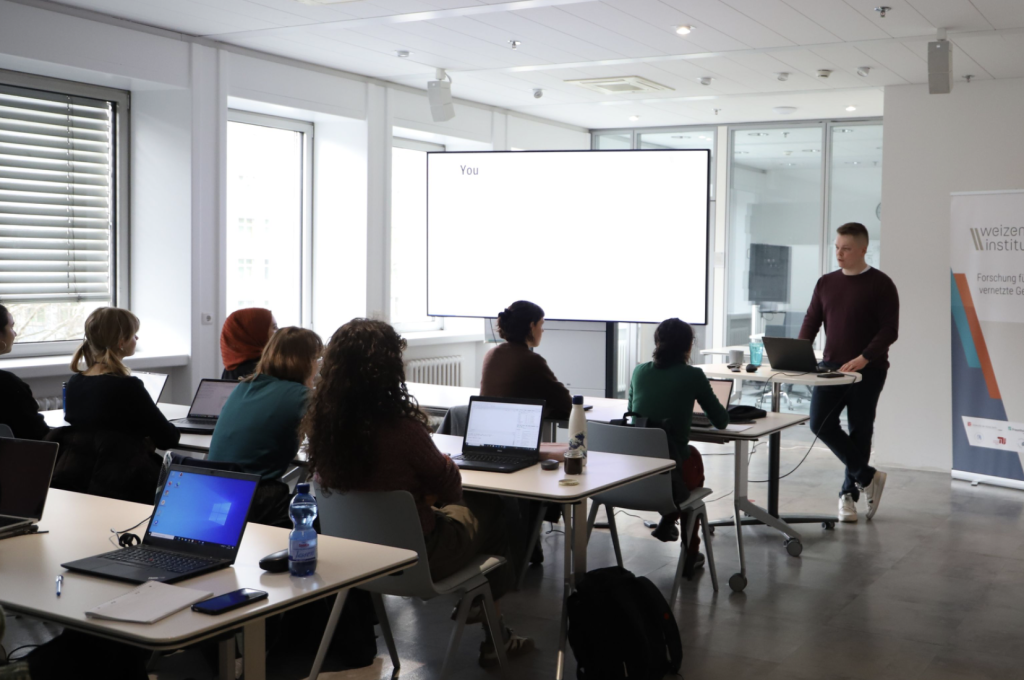
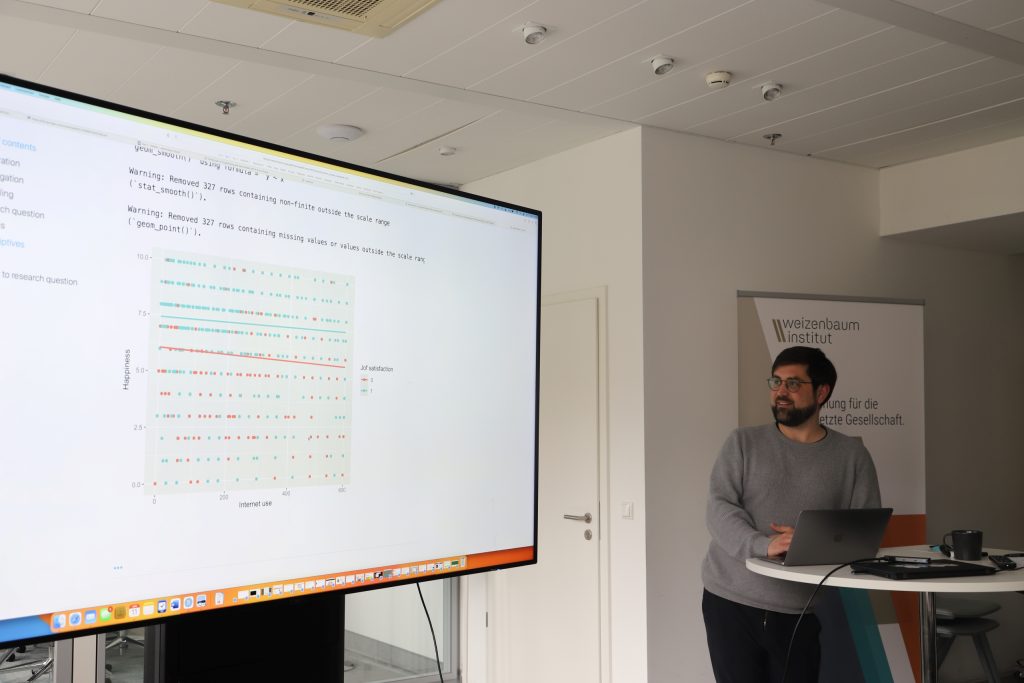
Roland asks participants about their former experience with programming
On the first day, Roland guided participants through the basics of R syntax and its integration with Markdown/Quarto in an interactive environment. This included the very basics of programming like functions, objects, and indexing, but also data-related practices like data wrangling, sanity checks, and simple statistical analyses. Among others, participants also gained insight on managing warnings and errors that might stunt the process of coding throughout projects.
On day two, after an introduction to data visualization techniques, participants put their learning into practice: They explored provided survey data and developed a research question, so they could prepare and statistically analyze the data accordingly in R. The result was a reproducible HTML report on the reasoning behind the research question, all data wrangling steps, an exploration of the data set, the analysis, and the results including an interpretation. Attendees also supported each other’s progress whenever possible, while Roland offered personalized guidance.
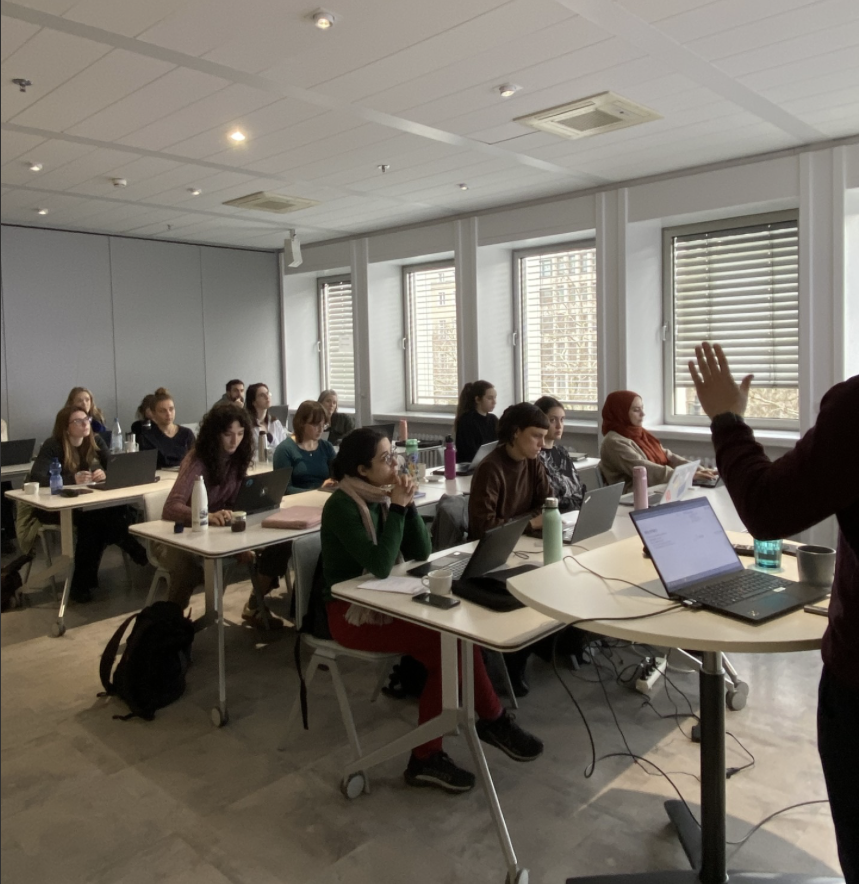
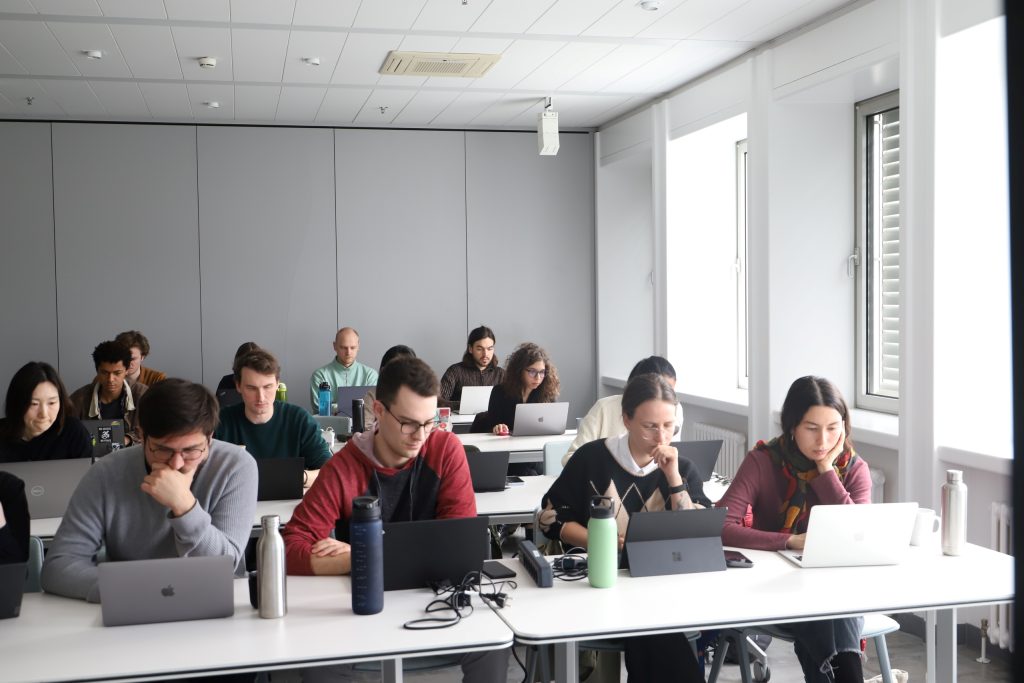
The workshop alternated between lecture-like and interactive formats
The workshop concluded with a thorough review of useful functions and packages in R. Throughout the event, participants were encouraged to ask questions freely and frequently, and they took the opportunity. The Methods Lab would like to give a great thanks to all guests for their attendance and lively participation!
On April 10th and 11th, The Methods Lab organized the second edition of the workshop Introduction to Programming and Data Analysis with R. Led by Roland Toth from the Methods Lab, the workshop was designed to equip participants with fundamental R programming skills essential for data wrangling and analysis.
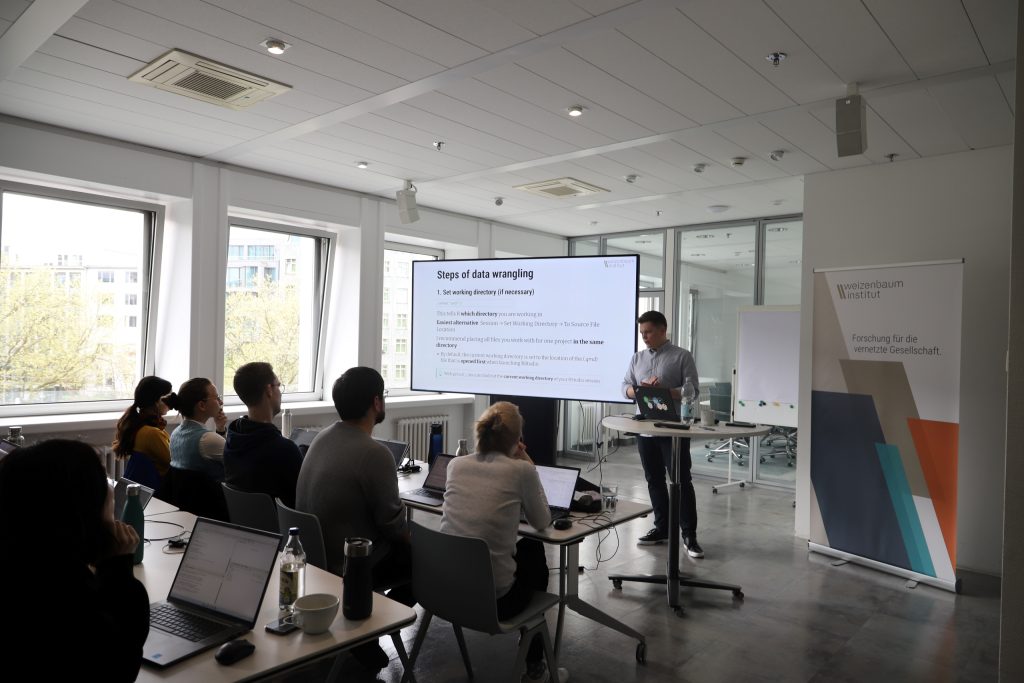
Roland Toth introduces participants to data wrangling with R
Across two days, attendees engaged in a comprehensive exploration of R fundamentals, covering topics such as RStudio, Markdown, data wrangling, and practical data analysis. Day one focused on laying the groundwork, covering the main concepts in programming including functions, classes, objects, and vectors. Participants were also familiarized with Markdown and Quarto, enabling them to include analysis results while producing text, and the key steps and techniques of data wrangling.
Participants work on their own research questions during the practical exercise
The first half of the second day was dedicated to showcasing and exploring basic data analysis and various visualization methods. Afterwards, participants had the opportunity to put into practice the knowledge they had gained from the previous day by working with a dataset to formulate and address their own research questions. Roland was on hand to offer assistance and guidance to the participants, addressing any challenges or concerns that arose along the journey.
Christian Strippel presents first results
The workshop fostered a collaborative learning environment, with lively discussions and ample questions from all. We thank all participants for their active involvement!
Level: Beginner/Intermediate Category: Data Analysis
After being well received last year, we’re happy to announce the return of our workshop Programming and Data Analysis with R for its second edition. This two-day intensive workshop led by Roland Toth (WI) will take place on Wednesday, April 10, and Thursday, April 11, at the Weizenbaum Institute.
During the first day, attendees will receive comprehensive training in programming fundamentals, essential data wrangling techniques, and Markdown integration. The second day will center around data analysis, providing participants with the chance to engage directly with a dataset and address a research topic independently. A blend of concepts, coding techniques, and smaller practical tasks will be interspersed throughout both days to reinforce hands-on learning.
Day 1, section Introduction to Markdown (photo: Katharina Stefes).
From March 29-30, the Methods Lab organized a workshop on the use of the programming language R for working with data, led by Roland Toth. The focus was on the main principles of programming in order to understand what is happening under the hood when working with data.
Day 1 focused on the advantages of using a programming language to work with data over dedicated software such as SPSS or Stata. In the course of this, the most important principles of programming in a research context, such as functions, classes, objects, vectors, and data frames were covered. Before going into the specific tasks in the context of data analysis, the markup language Markdown in combination with R was first introduced. This allows data analyses to be not only performed, but also reported in a directly reproducible and seamlessly interrelated manner, so that entire research papers can be written using R and Markdown. The day concluded by covering the key steps and techniques in data wrangling and performing calculations of typical descriptive and inferential statistical measures, tests, and models. At the end of each section of the day, there were small tasks to be solved by the participants to apply what they had learned.
On Day 2, the data analysis section was wrapped up with a demonstration of numerous visualization methods. This was followed by a longer section in which participants were allowed to think about their own research question based on a freely available data set from the European Social Survey (ESS) and answer it in R using all the techniques they had learned. They were supported by the workshop leader, since at the beginning of working with a programming language there are often many small, unforeseen problems that can quickly lead to frustration without prior experience. Lastly, an outlook was given on what techniques and packages to familiarize oneself with once beginning to dive deeper into data analysis in R and programming in general (for example, custom functions, loops, and pipes). The workshop was concluded with a Q&A where remaining questions could be asked.
For the purpose of optimizing the training offered by the Methods Lab, a short, anonymous evaluation was conducted at the very end of the workshop. Thankfully, the participants were very satisfied with the workshop throughout and only commented that more frequent and smaller tasks might have been even better. Although this is in parts difficult to reconcile with the concept of the workshop, this feedback is appreciated and will be used to improve future offerings in this regard.
The Methods Lab would like to thank all participants for their participation and commitment and hopes that the skills learned will be of benefit to them in future research projects and other application scenarios.
Our second workshop, Programming and Data Analysis with R, will be held on March 29 and 30 at the Institute.
During the first day of the workshop, Roland Toth (WI) will introduce and establish the fundamentals of programming in R/R Studio, combining it with Markdown. Building of the first, the second day will be dedicated to applying this knowledge to data analysis and working on a custom research question. No previous experience is necessary.
You can find more information about the workshop on its program page.
Manage Cookie Consent
To provide the best experiences, we use cookies to store and/or access device information. Consenting to these technologies will allow us to process data such as browsing behavior or unique IDs on this site. Not consenting or withdrawing consent, may adversely affect certain features and functions.
Functional
Always active
The technical storage or access is strictly necessary for the legitimate purpose of enabling the use of a specific service explicitly requested by the subscriber or user, or for the sole purpose of carrying out the transmission of a communication over an electronic communications network.
Preferences
The technical storage or access is necessary for the legitimate purpose of storing preferences that are not requested by the subscriber or user.
Statistics
The technical storage or access that is used exclusively for statistical purposes.The technical storage or access that is used exclusively for anonymous statistical purposes. Without a subpoena, voluntary compliance on the part of your Internet Service Provider, or additional records from a third party, information stored or retrieved for this purpose alone cannot usually be used to identify you.
Marketing
The technical storage or access is required to create user profiles to send advertising, or to track the user on a website or across several websites for similar marketing purposes.