The Methods Lab is happy to announce the workshop Advanced Data Wrangling with R, led by Roland Toth (WI). The single-day workshop will take place at the Weizenbaum Institute on Wednesday, November 11.
Building on foundational knowledge, this workshop dives deep into the power of R for transforming raw, messy data into clean, structured information. Participants will explore the potential of the tidyverse ecosystem, learn efficient data manipulation with dplyr and the pipe operator, advanced string processing using regular expressions, and creating reusable functions to automate repetitive tasks. A key highlight is the integration of Quarto, which allows to generate fully reproducible reports directly from code. Whether you’re working with survey responses, longitudinal data, or complex text, this workshop equips you with the tools to streamline your data wrangling workflow and ensure reproducibility from start to finish.
Beginner to intermediate experience with R or another programming language, and a basic understanding of descriptive statistics, are required.
Seats are limited to 20 participants. For more details, visit the event page!
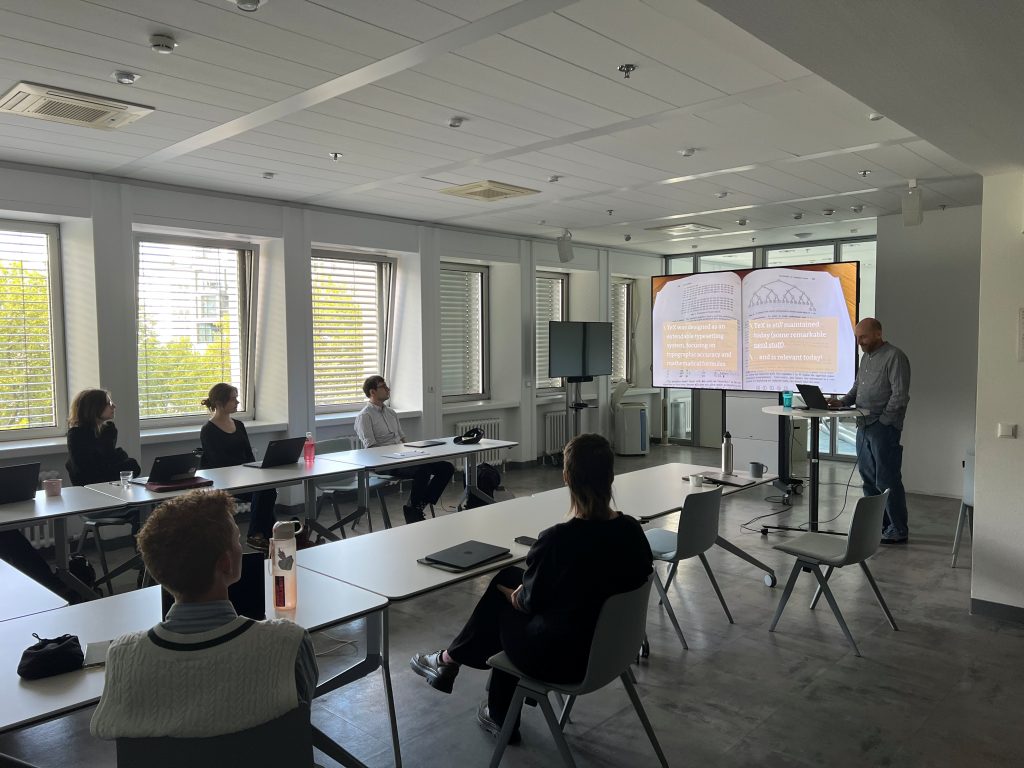
On September 10, 2026, Roland Toth (Methods Lab) and Jochen Knaus (Research Management) hosted the workshop Introduction to LaTeX and Overleaf at the Weizenbaum Institute. This hands-on session introduced participants to the fundamentals of LaTeX and the collaborative online platform Overleaf, equipping researchers with essential tools for precise, reproducible, and professional scientific writing.
In the first part, LaTeX’s origins were traced back to Donald E. Knuth’s 1978 creation of TeX, born from frustration with poor digital typesetting. Built on TeX, LaTeX separates content from formatting, letting authors focus on structure while the system handles layout – a principle still vital for academic writing, math-heavy documents, and long-form research. This part highlighted key advantages of LaTeX over traditional word processors like Microsoft Word or Google Docs:
Plain text source files ensure version control, reproducibility, and compatibility with modern data science workflows.
Automated PDF generation from source code allows seamless integration with tools like R Markdown, Quarto, Sweave, and PyLaTeX.
Robust support for citations and bibliographies via BibTeX and reference management tools (e.g., Zotero, Mendeley).
AI-friendly format: vast corpora of scientific literature in LaTeX are widely used to train generative AI models.
Jochen Knaus presents the origins of LaTeX
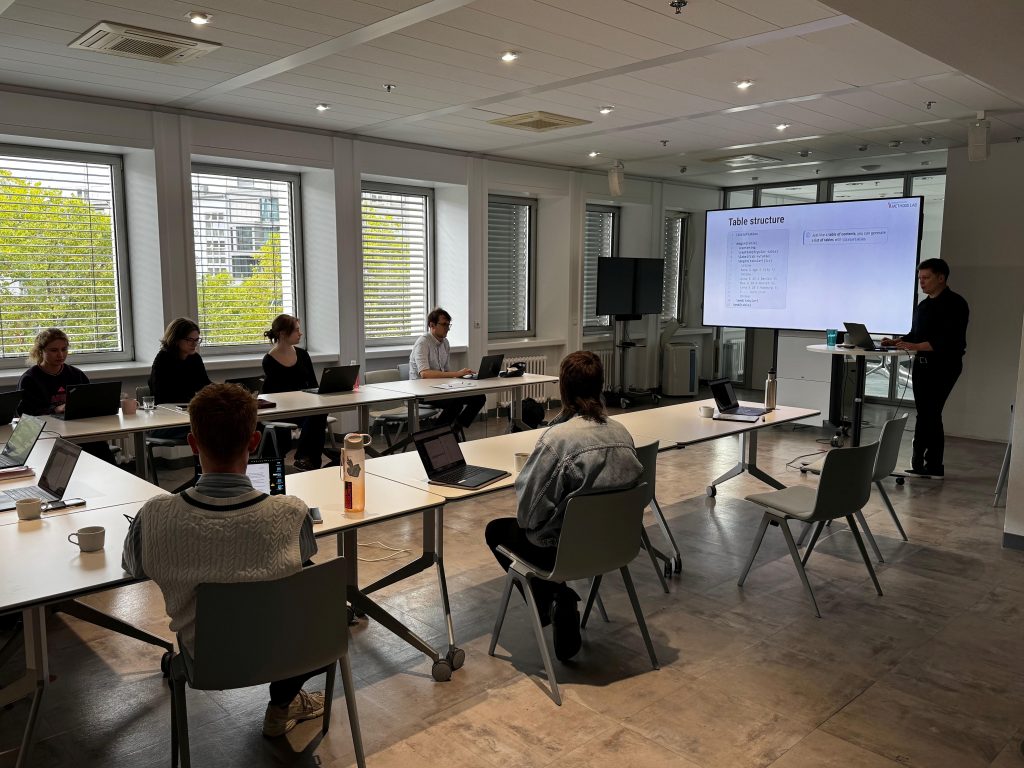
Participants were then introduced to Overleaf, the web-based LaTeX editor, which offers real-time collaboration, cloud storage, and a user-friendly interface – ideal for both beginners and experienced users. The Weizenbaum Institute’s own secure instance at https://overleaf.weizenbaum-institut.de was emphasized as a privacy-conscious alternative to the public version, which can also be used to collaborate with multiple people without requiring licenses. The core of the workshop was a hands-on exploration of LaTeX syntax and document structure. Throughout the session, participants were guided through practical exercises for each technique. Participants learned how to:
Set up a new project, manage files, and use the Overleaf interface
Structure documents and format text
Create structured content using sections, subsections, and subsubsections
Insert lists, tables, and figures with captions and labels
Cite literature systematically using .bib files
Troubleshooting common errors such as missing braces, undefined labels, and incorrect file paths.
Roland Toth guides participants through LaTeX syntax
In the final segment, participants were given an opportunity to convert the format of a sample paper using a journal template, which is a typical task in scientific writing and publishing.
Participants left with a working knowledge of LaTeX and Overleaf, and the confidence to begin writing their next paper, thesis, or proposal in a format ensuring precision, consistency, and long-term sustainability.
We are pleased to announce the launch of a new local instance of OpenQDA, now accessible at https://openqda.intern.weizenbaum-institut.de/. This instance is hosted within the Weizenbaum Institute and provides researchers with a dedicated, secure environment for qualitative data analysis. As of now, LDAP authentication is not yet implemented, so access requires being on the Weizenbaum Institute network or connected via VPN. To create a new account, please access the link at the bottom of the landing page.
OpenQDA, developed by ZeMKI at the University of Bremen, is a free, open-source, web-based alternative to the commercial software MAXQDA. It supports core coding functions, follows the REFI standard for project interoperability, and enables collaborative workflows with versioning and shared codebooks. The platform also offers basic visualizations and is designed with GDPR-compliant data handling in mind.
This local instance builds on our earlier announcement of OpenQDA and reflects our commitment to open, collaborative, and ethically responsible research practices. The full source code is available on GitHub under the GNU Affero General Public License v3.0, and the ZeMKI welcomes feedback and contributions from the research community.
We encourage all researchers to explore the platform and help shape its development!
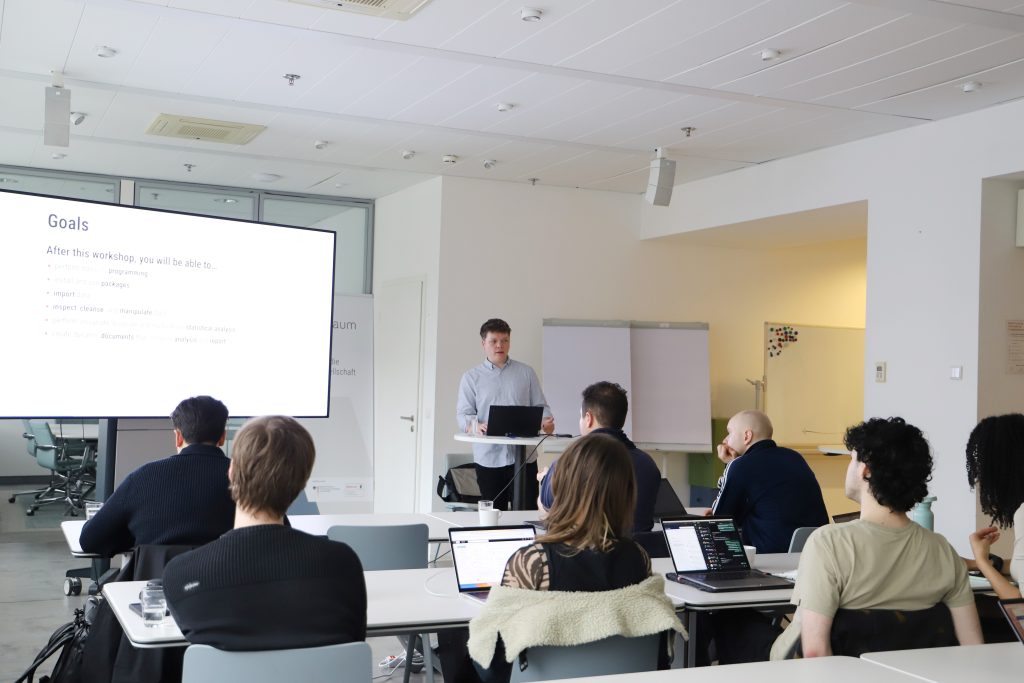
The fourth edition of our Introduction to Programming and Data Analysis with R workshop took place on March 25 and 26, 2026 continuing the tradition of hands-on, beginner-friendly training in R—a powerful tool for data science and statistical analysis. For those who attended previous editions, the structure and content remained familiar and effective: a two-day immersive experience covering the fundamentals of R syntax, Markdown/Quarto, data wrangling, analysis, visualization, and reproducible research practices. If you are new to R, or looking to refresh your skills, this workshop remains a great starting point.
Roland Toth provides an overview of the workshop goals
We’re proud to see a consistent number of participants attending each year. The workshop’s format has been shaped by feedback from past attendees, and we have kept the core curriculum intact to ensure a smooth learning curve. If you missed this year’s session, you can still explore the material through our previous recaps:
These posts offer summaries and key takeaways—perfect for catching up or preparing for the next edition. Stay tuned for updates on the 2027 workshop, and keep coding with R! 📊💻
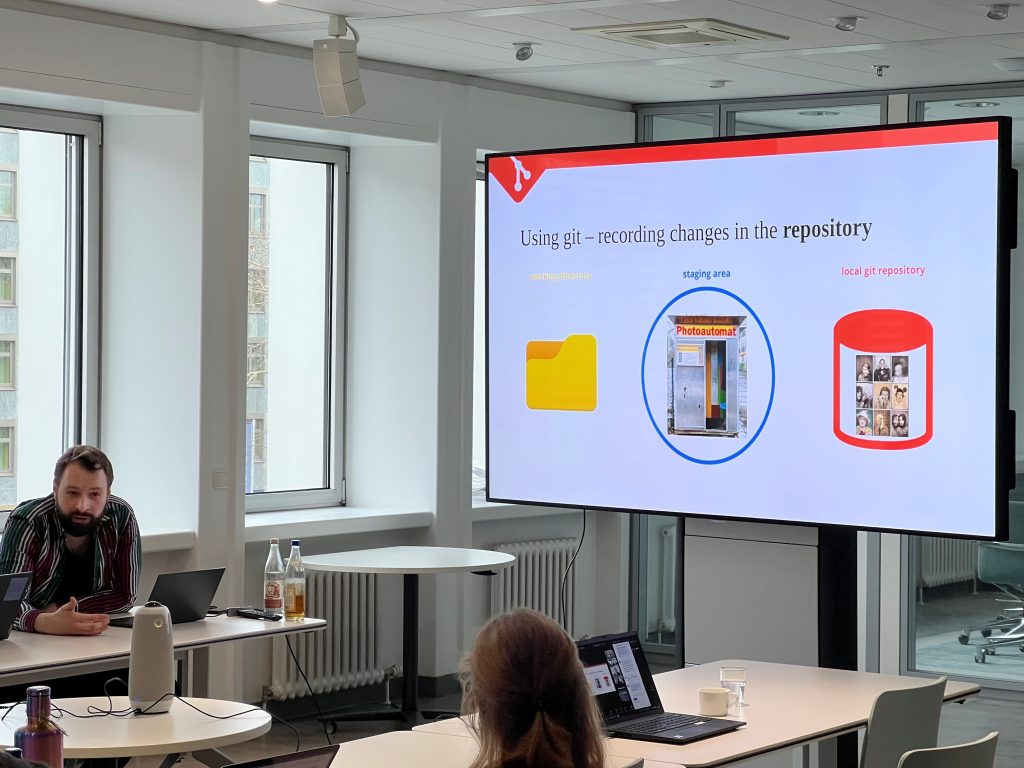
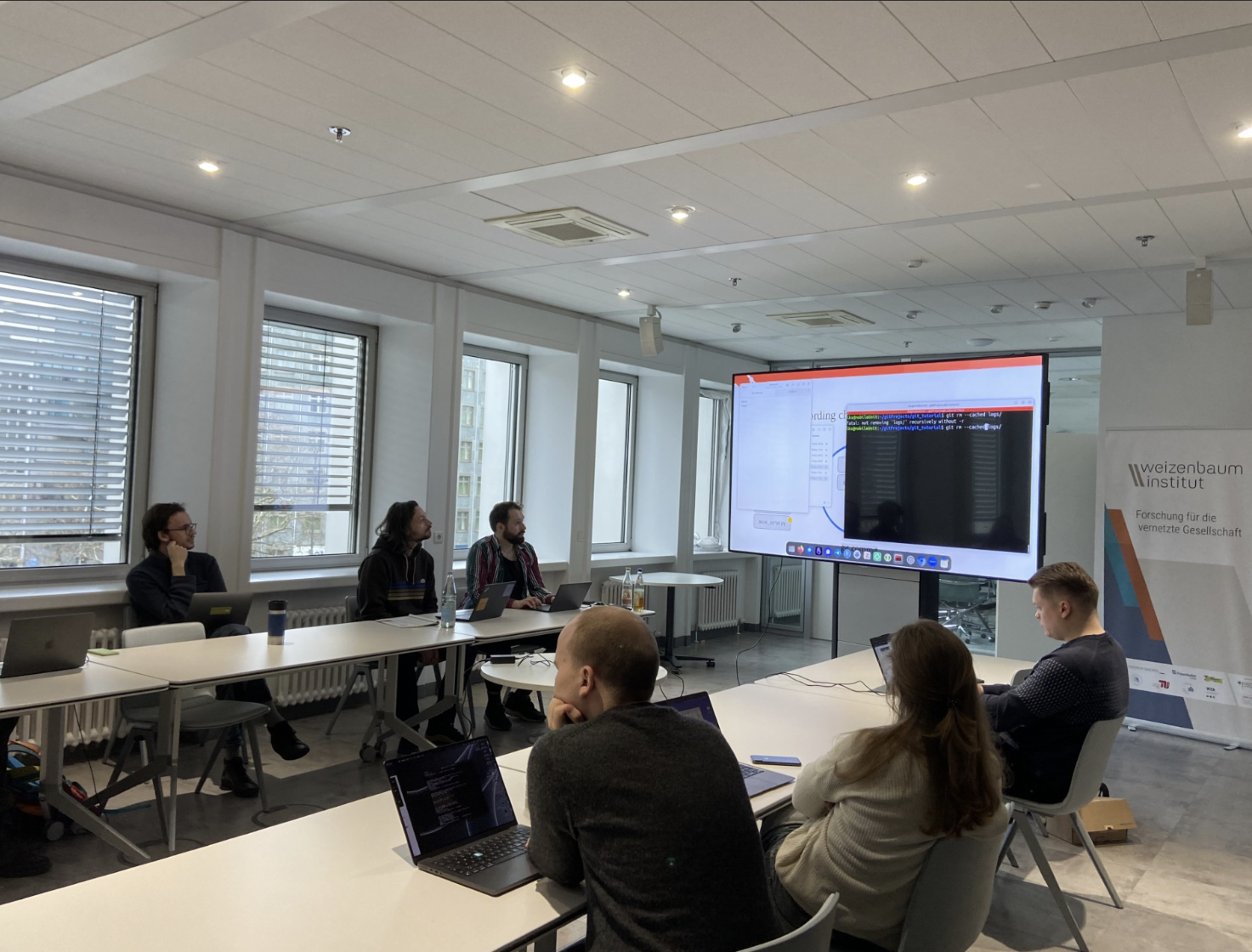
On February 6th, 2025, LK Seiling facilitated a workshop for an Introduction to Git, with support from Sascha Kostadinoski and Quentin Bukold. This was co-organized by the Methods Lab and took place at the Weizenbaum institute. The hybrid event provided a thorough overview on the foundation of Git and its relative platforms for about 30 participants.
Firstly, Git was introduced for its general relevance. Seiling explored the qualities of its version control system and the advantages of efficiently managing changes to files. Its widespread use and accessibility were also highlighted by the software’s free and open source application. At its core, Git enables collaborative work by allowing concurrent adjustments to files by multiple participants and offers a system to track the changes made without requiring alterations to the original file.
Next, participants were invited to open the Terminal and guided through some basic commands. To this end, commands for traversing directories, creating, moving, organizing, and deleting files were explained and demonstrated in detail.
LK Seiling explains how to stage and commit changes
In the second hour of the workshop, Seiling encouraged participants to implement these basics by imagining the context of a classic Python project, one that might require collaborative engagement. Here, Python scripts were saved, renamed and staged accordingly to git messages and configurations. The principle git practices were emphasized to remind the audience of when and how to commit changes to the previously specified local repository. Furthermore, Seiling prepared guests to make requests when merging work, added description templates for joint projects and generally taught the features of use for group collaboration.
This was followed by instructions on the key functionality of Git, such as the Git repository, Git commands, branches, and conflict resolution. For instance, the branches gave insight into how to leverage simultaneous work done separately from the overall code base. This is especially beneficial for feature development while also helping to streamline the process of reviewing changes before merging. Throughout this instruction, commands were given to switch branches and merge scripts in the terminal, which was operationalized with a quickly constructed example. Seiling also provided necessary information on managing repositories, including visuals of the basic workflow and linkage between local and remote repositories, either for individual or collaborative effort.
For those curious when to use which Git platform, Bukold jumped in to detail the major differences between Github, Gitlab and Git.
Terminal commands are used to perform actions with Git
Later, Seiling explored some advantageous elements of the GitLab platform, accessible free of charge to Weizenbaum researchers, by describing the repository graph, issue tracking and project management tools. To elaborate, the repository graph structures insight into how a participant makes a contribution or change by arranging branches to show merges or commits, particularly relevant for collaborative code projects. In case of software malfunctioning, the issue tracking feature allows one to see who is working on what branch for an update on the progress of the problem. Finally, Gitlab’s management tool was outlined for instances of assigning work, applying tags to notify when projects are finished and to open or close potential issues.
To close, Kostadinoski briefly summarized the basic elements of Git, along with its implications in data work, such as for software development and research. He simplified key terms and embraced questions in a Q&A. Seiling joined in, encouraging participants to “learn by doing” and stay connected with each other via Weizenbaum associated Github accounts for future internal coordination.
Throughout this workshop, participants were presented with various tasks and benefited from frequent recaps that highlighted key points, ensuring a solid understanding of the material. Attendees both online and in person freely asked questions and received support from instructors. Therefore the Methods Lab would like to give a huge thank you to LK Seiling, Sascha Kostadinoski and Quentin Bukold for their clear instruction on the foundations of Git and for facilitating such an engaging environment for all participants.
The Weizenbaum research groups “Digital Economy, Internet Ecosystem, and Internet Policy” (Jan Batzner) and “Data, Algorithmic Systems and Ethics” (Dr. Fatma Elsafoury), supported by Fraunhofer FOKUS and TU Berlin, with contributors Zeerak Talat and Flor Miriam Plaza del Arco, are excited to introduce the workshop “Social Science and Language Models – Methods and theory to responsible research on and with Language Technologies” taking place on April 3–4, 2025 at the Weizenbaum Institute. This hybrid event encourages interdisciplinary collaboration to promote ethically responsible research in the application of natural language technology. As methodology utilizing language models is increasingly applied to a variety of contexts from social science, health-care settings to computer software development, research suggests the growing need to monitor potential biased outcomes of its use. However, the absence of collaborative understanding between researchers of social science and those in Natural Language Processing (NLP), perpetuates discrimination as biases in the conception and measurement of socio-technical systems often go unrecognized.
Therefore we hope to engage a diverse group of researchers involved in the methodology of social or economic fields of discipline to address this prejudice in language technologies. Submissions of abstracts are encouraged to involve aspects of bias in the mitigation and measurement of NLP, as well as its implications in the social sciences.
After another successful run, the Methods Lab is excited to bring back the third annual Programming and Data Analysis with R workshop, led by Roland Toth (WI). This two-day event held at the Weizenbaum institute falls on Wednesday, March12th and Thursday, March 13th.
On the first day, one can expect a comprehensive introduction to the fundamentals of programming, essential data wrangling techniques and Markdown integration. Following this, the second day emphasizes data analysis and incorporates hands-on application of datasets, enabling attendees to independently explore a relevant research topic. Throughout both days, participants will be presented with conceptual knowledge, coding techniques and basic subtasks for a practical and immersive learning experience.
To provide the best experiences, we use cookies to store and/or access device information. Consenting to these technologies will allow us to process data such as browsing behavior or unique IDs on this site. Not consenting or withdrawing consent, may adversely affect certain features and functions.
Functional
Always active
The technical storage or access is strictly necessary for the legitimate purpose of enabling the use of a specific service explicitly requested by the subscriber or user, or for the sole purpose of carrying out the transmission of a communication over an electronic communications network.
Preferences
The technical storage or access is necessary for the legitimate purpose of storing preferences that are not requested by the subscriber or user.
Statistics
The technical storage or access that is used exclusively for statistical purposes.The technical storage or access that is used exclusively for anonymous statistical purposes. Without a subpoena, voluntary compliance on the part of your Internet Service Provider, or additional records from a third party, information stored or retrieved for this purpose alone cannot usually be used to identify you.
Marketing
The technical storage or access is required to create user profiles to send advertising, or to track the user on a website or across several websites for similar marketing purposes.